The White House has just changed the game for American retirees.
Whilst most coverage so far has focused on loosening the rules for investments in commodities such as Bitcoin and Gold and enabling access to private equity markets in 401(K) plans, perhaps the most significant change was overlooked.
Firstly, it's worth noting that during President Trump's first term in office, he was tasked with implementing the "Fiduciary Rule" which required lifetime income products for retirement plans to be offered by fiduciaries. This was intended to prevent conflicts of interest and to ensure that advisors and issuers were always acting in the best interests of savers. Ultimately his first administration lacked the power to push this rule through.
Then in 2022, the OECD issued legal Instrument 0467 recommending that member countries, including the US, make lifetime income strategies mandatory by default for retirement accounts using either Tontines or Annuities. Little response has been seen or heard, until now.
Cue the Executive Order released last week (see full text below) which mandates that fiduciaries should now be allowed to offer:
Tontines,
Backed by Bitcoin and/or Gold,
With optional allocations to Private Equity for Accredited Investors.
As a result, retirement savers and their plan administrators are no longer restricted to offering insured lifetime income products backed by traditional assets. Savers can now compare the strategies and decide which they trust more from the following options:
| Fixed Annuities | Tontines | |
|---|---|---|
| Offered by | Commission Agents and Insurers obligated to act in the best interests of their shareholders | Fiduciaries obligated to act in the best interest of the Savers |
| Security | The Saver is a creditor of a fractionally reserved Insurer which is a member of an unfunded state guarantee scheme | The Saver is the beneficiary of a standalone Trust and the segregated assets held therein during their lifetime |
| Costs borne by the Saver | Embedded sales commissions, guarantee costs, management fees | A flat 1% per year administration fee |
| Nature of the Offer | Insurers are not liable for risks disclosed in the offering document, including if the insurer transfers or assigns its obligations to make the annuity payments to an offshore entity such as a Reinsurer in Bermuda | Fiduciaries are required to act in the best interests including the ongoing monitoring and mitigation of any risks that arise |
| Asset backing | The general balance sheet of a fractionally reserved Insurer or Re-insurer | Segregated holdings of traditional investments or non-standard assets such as Bitcoin, Gold or Private Equity as preferred by the Saver |
How US Savers will respond to Tontine offerings has yet to be seen however it is notable that the last time that Tontines were widely available in the US that the Tontines outsold Annuities by 5 to 1.
FULL TEXT OF THE EXECUTIVE ORDER
By the authority vested in me as President by the Constitution and the laws of the United States of America, it is hereby ordered:
Section 1. Purpose. Many wealthy Americans, and Government workers who participate in public pension plans, can invest in, or are the beneficiaries of investment in, a number of alternative assets. Yet, while more than 90 million Americans participate in employer-sponsored defined-contribution plans, the vast majority of these investors do not have the opportunity to participate, either directly or through their retirement plans, in the potential growth and diversification opportunities associated with alternative asset investments.
Fiduciaries of 401(k) and other defined-contribution retirement plans must carefully vet and consider all aspects of private offerings, including investment managers’ capabilities, experiences, and effectiveness managing alternative asset investments. They do so to protect the Americans whose retirement accounts they administer and for whom they have fiduciary duties to invest safely and prudently.
During my first term, my Administration issued a 2020 information letter, recognizing that prudent Federal action could encourage the proliferation of investment strategies under which a portion of retirement plan participants’ interests are allocated to alternative assets, as is the case for institutional investors.
Burdensome lawsuits that seek to challenge reasonable decisions by loyal, regulated fiduciaries, and stifling Department of Labor guidance issued since my first term, however, have denied millions of Americans opportunities to benefit from investment in alternative assets. Such assets are an increasingly large portion of the portfolios of public pension plans and other defined-benefit retirement plans and offer competitive returns along with diversification opportunities.
A combination of regulatory overreach and encouragement of lawsuits filed by opportunistic trial lawyers has stifled investment innovation and largely relegated 401(k) and other defined-contribution retirement plan participants to asset classes whose returns lack the very same long-term net benefits allowed for and achieved by public pension plans and other institutional investors.
My Administration will relieve the regulatory burdens and litigation risk that impede American workers’ retirement accounts from achieving the competitive returns and asset diversification necessary to secure a dignified, comfortable retirement.
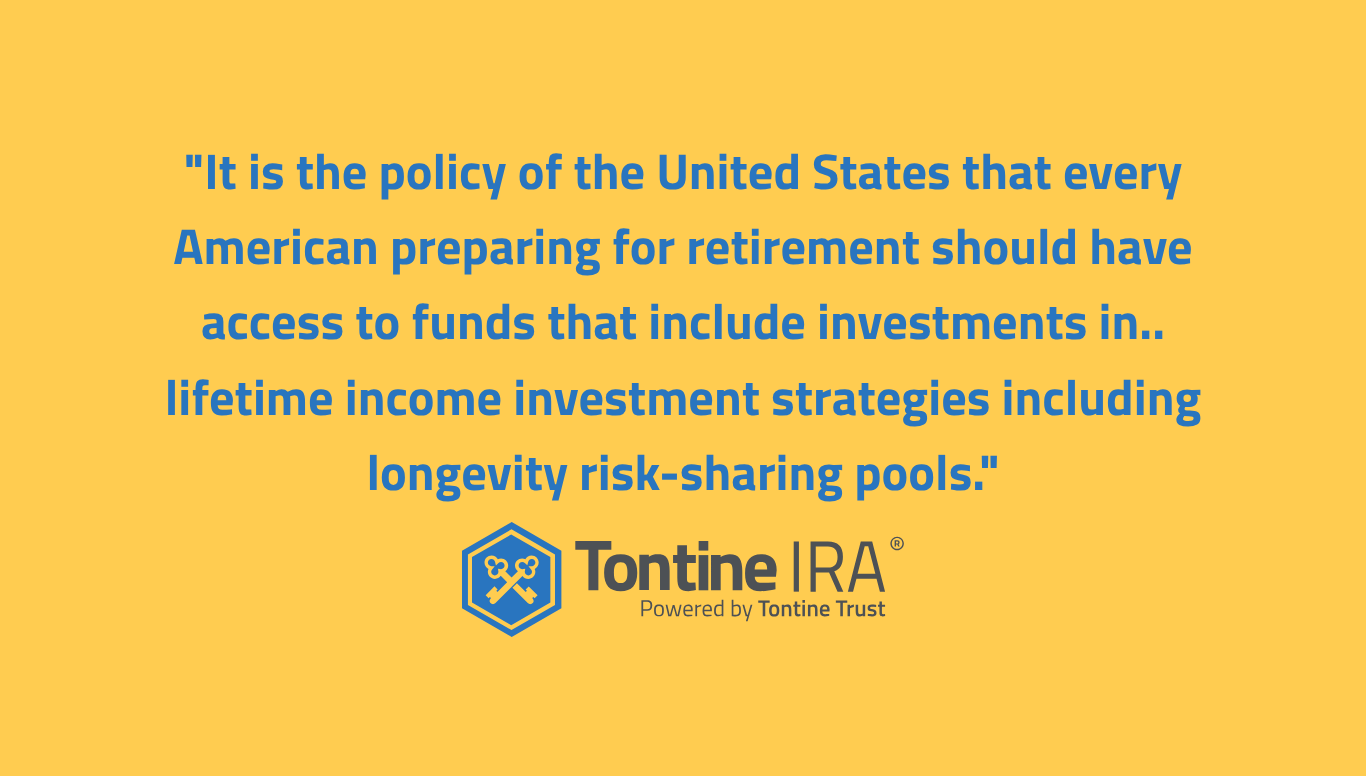
Sec. 2. Policy. It is the policy of the United States that every American preparing for retirement should have access to funds that include investments in alternative assets when the relevant plan fiduciary determines that such access provides an appropriate opportunity for plan participants and beneficiaries to enhance the net risk-adjusted returns on their retirement assets.
Sec. 3. Democratizing Access to Alternative Assets. (a) For purposes of this order, the term “alternative assets” means:
(i) private market investments, including direct and indirect interests in equity, debt, or other financial instruments that are not traded on public exchanges, including those where the managers of such investments, if applicable, seek to take an active role in the management of such companies;
(ii) direct and indirect interests in real estate, including debt instruments secured by direct or indirect interests in real estate;
(iii) holdings in actively managed investment vehicles that are investing in digital assets;
(iv) direct and indirect investments in commodities;
(v) direct and indirect interests in projects financing infrastructure development; and
(vi) lifetime income investment strategies including longevity risk-sharing pools.
(b) Within 180 days of the date of this order, the Secretary of Labor (Secretary) shall reexamine the Department of Labor’s past and present guidance regarding a fiduciary’s duties under the Employee Retirement Income Security Act of 1974, as amended (ERISA) (29 U.S.C. 1104), in connection with making available to participants an asset allocation fund that includes investments in alternative assets. When conducting this reexamination, the Secretary shall consider whether to rescind the Department of Labor’s December 21, 2021, Supplemental Private Equity Statement.
(c) Within 180 days of the date of this order, the Secretary shall further, as the Secretary deems appropriate and consistent with applicable law, seek to clarify the Department of Labor’s position on alternative assets and the appropriate fiduciary process associated with offering asset allocation funds containing investments in alternative assets under ERISA. Such clarification must aim to identify the criteria that fiduciaries should use to prudently balance potentially higher expenses against the objectives of seeking greater long-term net returns and broader diversification of investments. The Secretary shall also propose rules, regulations, or guidance, as the Secretary deems appropriate, that clarify the duties that a fiduciary owes to plan participants under ERISA when deciding whether to make available to plan participants an asset allocation fund that includes investments in alternative assets, which rules, regulations, and guidance may include appropriately calibrated safe harbors. In carrying out the directives in this section to further the policy set forth in this order, the Secretary shall prioritize actions that may curb ERISA litigation that constrains fiduciaries’ ability to apply their best judgment in offering investment opportunities to relevant plan participants.
(d) In carrying out the directives in this section, the Secretary shall, as appropriate, consult with the Secretary of the Treasury, the Securities and Exchange Commission (SEC), and other Federal regulators as necessary to carry out the policy objectives of this order, including as to parallel regulatory changes that may be incorporated by such other Federal regulators.
(e) The SEC shall, in consultation with the Secretary, consider ways to facilitate access to investments in alternative assets by participants in participant-directed defined-contribution retirement savings plans. Such facilitation may include, but not be limited to, consideration of revisions to existing SEC regulations and guidance relating to accredited investor and qualified purchaser status, to accomplish the policy objectives of this order.
Sec. 4. General Provisions. (a) Nothing in this order shall be construed to impair or otherwise affect:
(i) the authority granted by law to an executive department or agency, or the head thereof; or
(ii) the functions of the Director of the Office of Management and Budget relating to budgetary, administrative, or legislative proposals.
(b) This order shall be implemented consistent with applicable law and subject to the availability of appropriations.
(c) This order is not intended to, and does not, create any right or benefit, substantive or procedural, enforceable at law or in equity by any party against the United States, its departments, agencies, or entities, its officers, employees, or agents, or any other person.
(d) The costs for publication of this order shall be borne by the Department of Labor.
DONALD J. TRUMP
THE WHITE HOUSE,
August 7, 2025.